June 15, 2026
12×12 mm Frozen French Fries Manufacturer for Global Markets
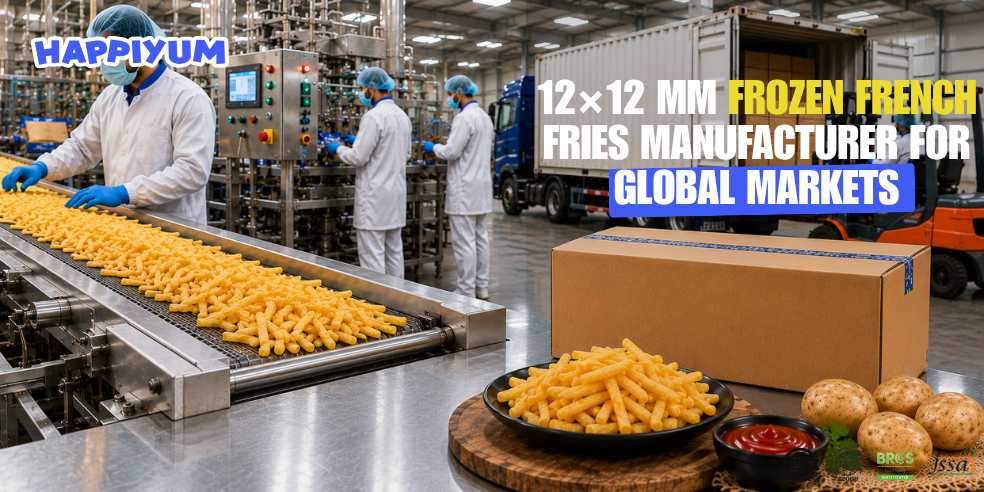 Frozen French fries seem like a straightforward food, until you consider that they're one of the most precisely engineered food types in world food production.
Whether it's with QSRs or big restaurant chains, consistency is expected as much as taste. All batches of fries should produce the same texture, color and performance. This is the reason why the frozen French fries are more popular than fresh cut fries.
Three fundamentals like potato quality, processing accuracy and standard sizing, are the hub of this uniformity. Compared to other sizes, 12x12 frozen French fries have become one of the most popular cuts on the market today due to their ideal balance of crispness and softness.
When it comes to choosing the right frozen fries manufacturer for global buyers, it's not simply a case of a product they want, but it is about the consistency and reliability that will be available for years to come.
Frozen French fries seem like a straightforward food, until you consider that they're one of the most precisely engineered food types in world food production.
Whether it's with QSRs or big restaurant chains, consistency is expected as much as taste. All batches of fries should produce the same texture, color and performance. This is the reason why the frozen French fries are more popular than fresh cut fries.
Three fundamentals like potato quality, processing accuracy and standard sizing, are the hub of this uniformity. Compared to other sizes, 12x12 frozen French fries have become one of the most popular cuts on the market today due to their ideal balance of crispness and softness.
When it comes to choosing the right frozen fries manufacturer for global buyers, it's not simply a case of a product they want, but it is about the consistency and reliability that will be available for years to come.
The Science Behind Potatoes Used in Frozen Fries
The potatoes used for processing are quite different from the table potato. Dry matter content is the most critical factor and should be greater than 20% ideal. The more dry matter, the less moisture, and the less moisture, the more crisp the fries will be after frying while absorbing less oil. However, potatoes with low dry matter yield soggy fries, a quality problem. The other important point is to cut down on sugar, particularly glucose and fructose. These sugars directly influence the Maillard reaction, which is the chemical reaction in frying that causes the browning. Fries get dark rapidly when they have high sugar content, and this is not acceptable in export markets. Evenness of the size is also significant due to uniformity in cutting and even cooking. The internal quality issues, such as hollow heart and black spots, may occur affecting both the appearance and texture. Storage is also a big factor. Starch has the potential to become sugar if the potatoes are not stored at a cold temperature, which can cause dark fries to occur during cold storage. That is why sugar levels are balanced.Why is India Emerging as a Frozen Fries Hub?
The growth of India's capability is the reason that India is becoming a strong player in the frozen fries market in India, and not only because of cost. Some areas, such as Gujarat perform best due to the best climatic conditions and cultivation practices. Contract farming ensures that specific potato varieties are grown for processing, maintaining consistency in quality. India has a huge cost benefit in both raw material and production compared to Europe. Infrastructure has also been upgraded as cold chain systems are enhanced, and units are being set up for export. This is not just because the scale, cost efficiency and technological advancements make India a reliable sourcing option for bulk frozen fries, but also because it enables the industry to offer various customizations. Also, the scale, cost efficiency, and evolving technology make India a dependable sourcing destination for bulk frozen fries, which also allows various customizations.What Makes 12×12 mm Frozen French Fries the Preferred Choice?
The size of a fry is directly related to its performance. The 12x12 frozen French fries give the fries a crispy crust and keep the inside moist. Thinner fries will burn and become dry, and thicker fries will stay too moist and will take longer to cook. A 12x12mm cut is right in the middle. It will also absorb less oil than thinner cuts and will have a better holding time after frying, which is important for take away and delivery. That's why 12x12 frozen French fries are the preferred option for QSR chains, they offer consistency, appearance, and performance in various service environments.Industrial Process Behind Frozen French Fries
Frozen French French fries are produced in a highly controlled manner. It starts with sorting and grading potatoes based on size. Potatoes are then peeled (steam or abrasive) and precision cut, all the same size. The next step is blanching; fries are partially cooked to remove excess sugars and deactivate enzymes. This is followed by par frying which gives a thin crust on the outside to help retain moisture. Fries are quickly frozen by IQF (Individual Quick Freezing) technology after frying. This helps to prevent big ice crystals which cause loss of texture and structure. Lastly, the fries are packed under controlled temperature conditions and stored at –18°C to ensure the quality from farm to fork.RELATED BLOGS
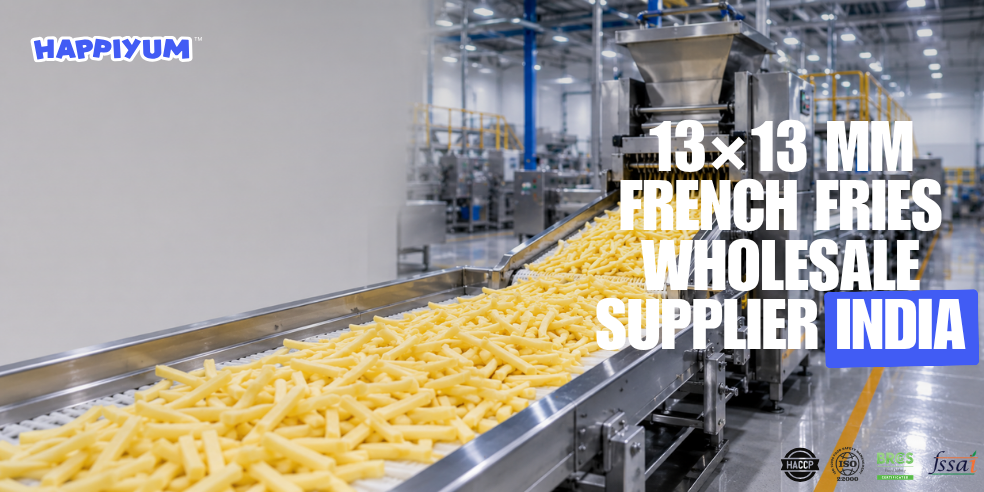
13×13 mm French Fries Wholesale Supplier India
When it comes to preparing food that people love, having fries that all taste great and are cut just right is super important. Lots of restaurants and food places around the world are choosing 13×13 mm fries because of this. Whether it’s a fast food chain or a small café, people want fries that are […]
Key Factors to Consider When Sourcing Potato Flakes From India
Finding potato flakes is seemingly a simple matter. However, when you begin, it’s a different story. One batch is OK. The other one doesn’t feel the same. Texture shifts. Absorption changes. The end product suffers. And that’s where most buyers get stuck. Potato flakes are more than simply dried potatoes. They’re more concerned about control. […]
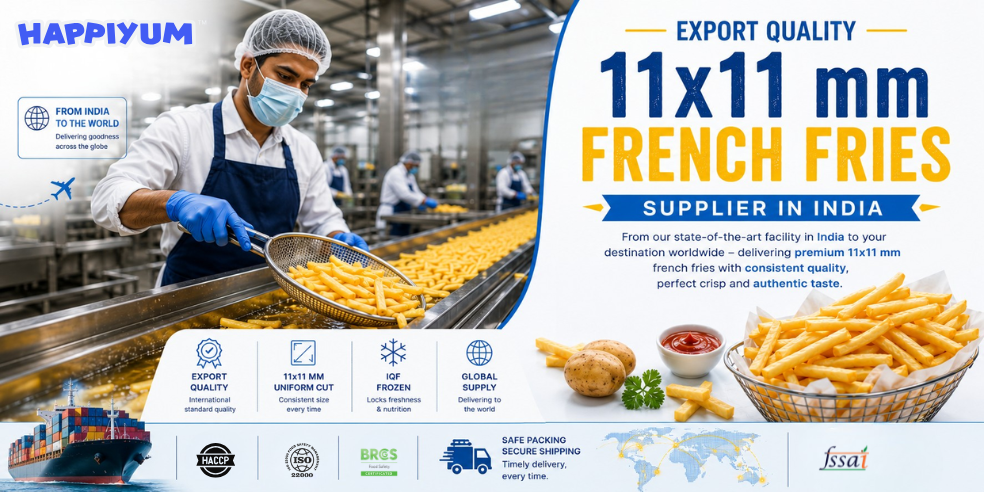
Export Quality 11×11 mm French Fries Supplier in India
Not all fries perform the same. Some are too thin, some lose their texture, and others fail to stay crispy after frying. That’s where 11×11 mm French fries make the difference. With a thicker cut, better bite, and stronger structure, they deliver a more satisfying experience while maintaining consistency in both appearance and performance. More […]